In the ever-evolving landscape of photonics and fiber optic technologies, V-groove fiber arrays have emerged as a crucial component for achieving precision alignment and high-density optical packaging. Whether in advanced laboratories, high-tech manufacturing environments, or university research centers, these components enable seamless light transmission, device miniaturization, and cost-efficient production.
In this article, we'll explore what a V-groove fiber array is, how it works, its main applications, advantages, and why MEISU has become a trusted supplier of high-quality V-groove fiber arrays across industries.
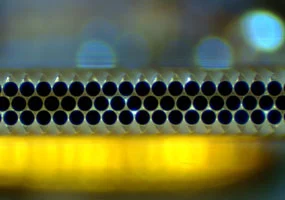
A V groove fiber array is an optical device where multiple optical fibers are precisely aligned and held in place by a silicon or quartz substrate with etched V-shaped channels (grooves). Each groove serves as a physical guide to position the fiber accurately, ensuring that the core alignment across fibers is consistent and stable.
These arrays are commonly used to connect optical fibers with waveguides, photonic integrated circuits (PICs), and other fiber-based components, where alignment accuracy at the micron level is critical.
The precision of V-groove fiber arrays comes from their design:
Substrate Creation: A silicon or quartz wafer is etched using photolithography and anisotropic wet etching, forming V-shaped channels.
Fiber Placement: Optical fibers are laid into these grooves, with the groove angle and depth ensuring lateral and vertical alignment.
Fixing and Polishing: The fibers are fixed using UV adhesives or thermal bonding, then polished at desired angles (usually 0° or 8°) to minimize reflection.
V-groove fiber arrays serve as a foundational technology across a range of industries and research fields. Below is a summary of common use cases:
| Industry/Field | Application |
|---|---|
| Optical Communications | Fiber to waveguide coupling, PLC splitters, AWGs |
| Data Centers | High-density optical interconnects |
| Sensing | Fiber optic sensors for temperature, pressure, or strain |
| Universities/Labs | Photonics research and optical experiments |
| Quantum Computing | Photon alignment for quantum circuits |
| LIDAR and Imaging Systems | Multi-channel light input/output systems |
These arrays are especially valuable in situations where space, alignment accuracy, and scalability are vital.
V-groove design ensures core-to-core fiber alignment accuracy within ±1 µm, essential for reducing insertion loss and improving coupling efficiency.
Whether you need a 2-channel, 8-channel, or 32-channel array, V-groove structures can be easily scaled to match the application without compromising precision.
Thanks to their monolithic structure and small footprint, V-groove arrays are ideal for integration into compact devices and high-density optical modules.
Silicon-based etching processes are highly repeatable and cost-effective, making V-groove fiber arrays attractive for mass production.
With a substrate typically made of silicon or quartz, these arrays offer good thermal expansion matching to optical chips, ensuring reliable performance over a wide temperature range.
As a trusted provider of advanced fiber optic arrays, MEISU has developed a series of high-precision V-groove fiber arrays tailored to diverse industrial and academic needs.
Here's what sets MEISU apart:
Custom Channel Count: From 1 to 64 channels available based on customer requirements.
Polishing Angle Options: 0°, 8°, or custom angle polish to match your optical interface.
Single-Mode and Multi-Mode Support: Covers broad wavelength ranges and applications.
Strict Quality Control: Each FAU fiber array unit undergoes rigorous inspection for alignment accuracy and surface finish.
Rapid Prototyping and Delivery: Quick turnaround for both standard and custom orders.
Whether you're building photonic integrated circuits in a university lab or scaling up production for a sensing device, MEISU's V-groove fiber arrays provide the stability, flexibility, and precision you need.
When selecting a V-groove fiber array, consider the following technical aspects:
Fiber type: SMF, MMF, PMF fiber?
Core pitch: Commonly 127 μm or 250 μm, but customizable.
Channel count: How many fibers do you need?
Operating wavelength: Match with the system's transmission requirements.
Endface polish: 0° for normal use, 8° for angled physical contact.
Not sure what suits your project best? MEISU's engineering team offers free consultation and technical support.
From telecommunications to photonic research, V-groove fiber arrays have revolutionized how optical fibers are aligned, connected, and scaled. Their precision, modularity, and reliability make them indispensable in today's high-performance optical systems.
At MEISU, we bring years of optical packaging expertise to help you integrate the right fiber array solution into your application. Our customer-focused approach ensures not just quality products but long-term support and innovation.
What is a fiber array?
A fiber array is a precision optical component that arranges multiple optical fibers in a fixed pitch and geometry for efficient light transmission. Common configurations include single-row, V-groove, and 2D fiber array designs used in silicon photonics, optical switching, and high-density data center interconnects. A high-quality optical fiber array ensures low insertion loss, excellent channel uniformity, and reliable fiber-to-chip coupling performance.
What are the three types of fiber arrays?
The three most common fiber array types are:
Linear Fiber Array – Fibers arranged in a single row, widely used in PLC and transceiver applications.
2D Fiber Array – Fibers arranged in multiple rows and columns for high-channel-count optical connections.
Custom Fiber Array – Designed with specialized pitches, angles, or fiber counts to meet specific photonic packaging and testing requirements.
The choice depends on alignment accuracy, channel density, and system integration needs.
What is fiber array alignment?
Fiber array alignment is the process of accurately positioning an optical fiber array relative to another optical component, such as a photonic chip, waveguide, laser, or detector. Precise fiber array alignment is critical because even micron-level misalignment can significantly increase insertion loss and reduce coupling efficiency. Advanced active and passive alignment techniques are commonly used in silicon photonics, co-packaged optics, and high-speed optical communication systems to achieve optimal performance.
Is fiber optic becoming obsolete?
No, fiber optic technology is not becoming obsolete. In fact, demand for optical fiber arrays and advanced fiber connectivity solutions continues to grow with AI data centers, cloud computing, 5G networks, and silicon photonics. While wireless technologies expand accessibility, fiber optics remains the preferred solution for ultra-high bandwidth, low latency, and long-distance data transmission that wireless systems cannot match.
Last Updated: June 2026 -FAQs Updated
 English
 日本語
日本語 한국어
한국어 français
 Deutsch
 Español
 italiano
 русский
 português
 العربية